Blocking
"Blocking" is the film term for where the actors stand and which way they face. Instead of positioning each actor by hand, you pick a ready-made formation (a "primitive") and agentwood places everyone — scaled and rotated to fit the spot you chose.
Blocking arranges a group of actors into a named formation with one call. You pass a
blocking primitive and the actors to shot.block(primitive, *actors, at=anchor). There are 20
primitives across 2-, 3-, and 4-person groups.
from dsl.blocking import face_to_face, huddle_triangle, two_by_two

shot.block(face_to_face(), bob, anne, at=A1)      # 2
shot.block(huddle_triangle(), a, b, c, at=A1)     # 3
shot.block(two_by_two(), a, b, c, d, at=A1)       # 4
How it works
Each primitive defines a local offset + a yaw per slot. At apply time each slot is transformed:
world_position = anchor_origin + rotate_z(local_offset * actor_scale, anchor_theta)
world_yaw      = anchor_theta + slot_yaw
So actor_scale scales the gaps, the anchor's theta rotates the whole formation, and each
slot's own yaw sets which way that actor faces. The actor count must match the slot count.
The primitives
shoulder_to_shoulder · face_to_face · back_to_back · in_line · conversational_l
| face_to_face | shoulder_to_shoulder |
|---|---|
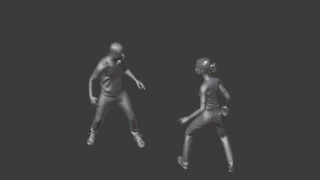 |
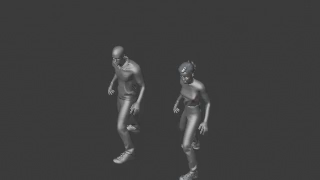 |
lecturer_triangle · leader_in_front · three_single_file · coach_behind ·
two_lead_one_follow · huddle_triangle · inward_row · attention_right
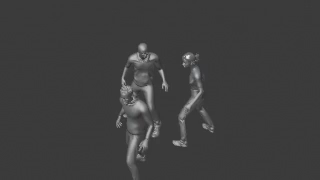
horizontal_line · four_single_file · two_by_two · diamond_forward ·
diamond_vip · arrow_wedge · square_inward
| two_by_two | square_inward (all face the centre) |
|---|---|
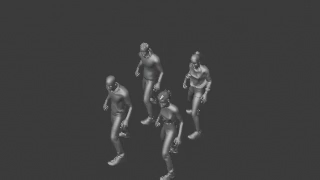 |
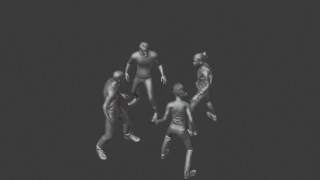 |
Tip
Most primitives accept gap / gap_x / gap_y overrides, e.g. face_to_face(gap=2.0).
The default face_to_face gap is 1.5; others default to 1.0–1.25.
Parameter reference
The dials are the gaps — spacing between actors, in subject units (then × actor_scale).
Larger = more space.
| Group | Dial(s) | Default | Controls |
|---|---|---|---|
| 2-person | gap |
1.0 (face_to_face 1.5) |
distance between the two actors |
conversational_l |
gap, who_faces |
1.0, "left" |
spacing + which actor turns in |
| 3-person | gap_x, gap_y |
1.0, 1.25 |
side-to-side / front-to-back spacing |
| 4-person | gap_x, gap_y (square_inward: gap) |
1.0, 1.25 |
grid spacing |
shot.block(face_to_face(gap=2.0), a, b, at=A1)            # more space between them
shot.block(two_by_two(gap_x=1.4, gap_y=1.6), a, b, c, d)  # looser grid
Realism levers
A two-hander staged too far apart / mis-faced reads wrong (#15):
tighten gap for intimacy, widen for tension. And the anchor's theta rotates the whole
formation — orient the group toward the camera or the scene action.
Staging a group for a beat: see Production-Quality Tuning.